
Reno Case File #005: $80K As-Is, $345K After Renovation
A Standard FHA 203(k) refinance created a path after challenged credit, a 55% debt ratio and an $80,000 as-is appraisal threatened a major renovation.
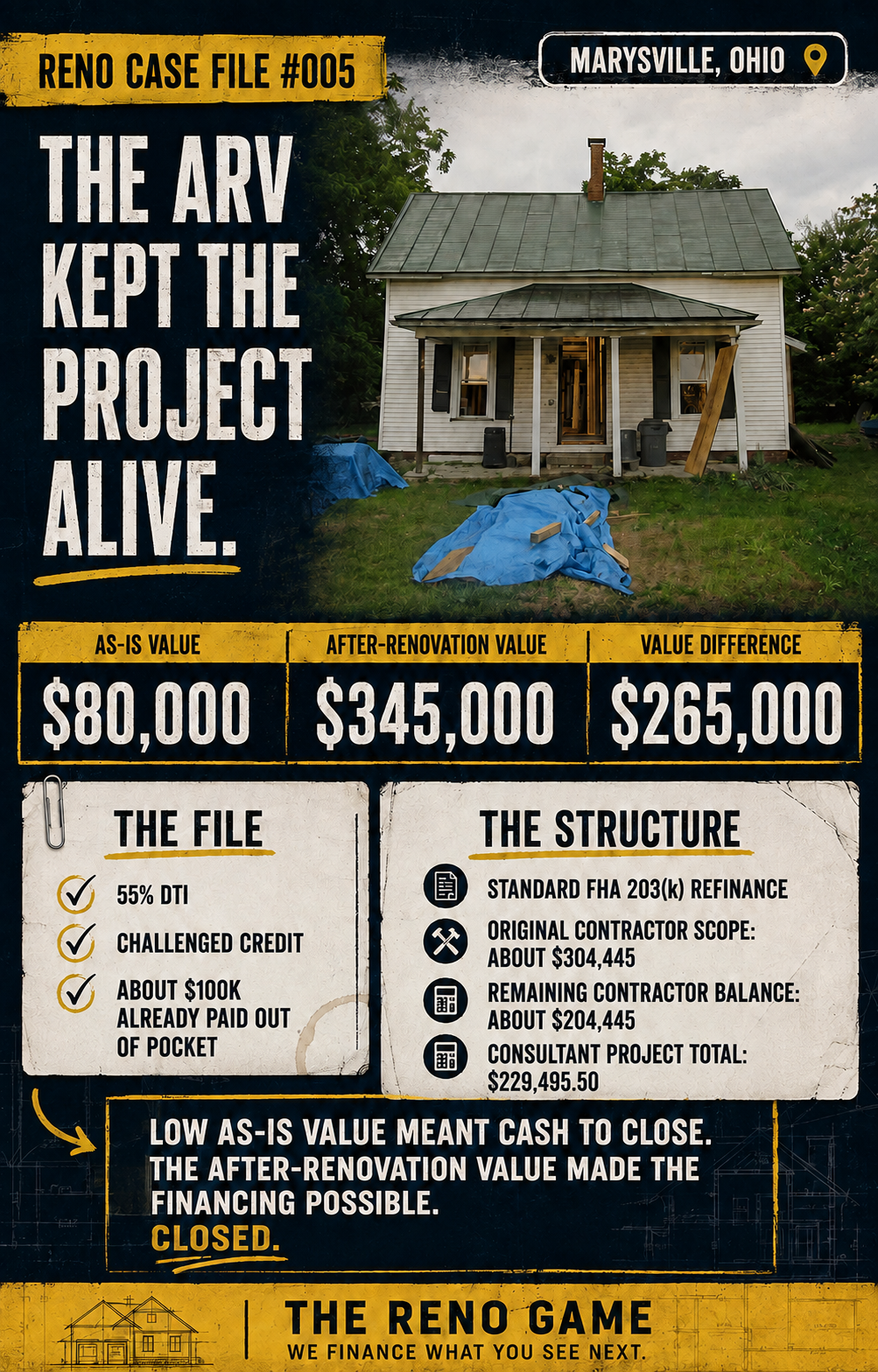
The borrowers had already put approximately $100,000 toward an original contractor scope of approximately $304,445. They were using retirement assets to keep the work moving, their family had been through a serious hardship, and the house was still nowhere close to finished.
Then the as-is appraisal came back at $80,000.
The completed appraisal told a very different story: $345,000 after renovation.
That $265,000 spread did not make the problems disappear. It gave us enough value to start solving them. We still had to work through challenged credit, a 55% debt-to-income ratio, a large remaining construction scope and cash required at closing.
This is how the deal came together.
Privacy note: Borrower names and the property address are withheld. Figures are taken from the transaction’s appraisals, contractor estimate and consultant work write-up. Certain amounts are rounded for readability. This case is an example of one completed transaction, not a promise that another borrower or property will receive the same result.
The Deal at a Glance
| Item | Documented result |
|---|---|
| Loan program | Standard FHA 203(k) refinance |
| As-is appraised value | $80,000 |
| After-improved appraised value | $345,000 |
| Difference between valuations | $265,000 |
| Original contractor scope | Approximately $304,445 |
| Prior borrower renovation outlay | Approximately $100,000 |
| Remaining contractor balance | Approximately $204,445 |
| Consultant construction subtotal | $204,455 |
| Consultant contingency reserve | $20,445.50 |
| Listed consultant and draw-related fees | $4,595 |
| Consultant’s total project worksheet | $229,495.50 |
| Estimated remaining construction period | Six months |
| Debt-to-income ratio | Approximately 55% |
This was not a cosmetic remodel. When the borrowers’ earlier outlay is combined with the remaining contractor estimate, the total renovation exposure was roughly $300,000.
How They Found Me
They found me the modern way.
They searched Google, used ChatGPT to research FHA 203(k) financing, landed on 203kmortgagelender.com and called me.
By then, they had already started the approximately $304,445 contractor project and paid approximately $100,000 upfront, leaving a balance of approximately $204,445. They had been liquidating retirement assets to cash-flow the renovation. That may keep a project alive temporarily, but it is a brutal way to finance a large rehabilitation. Every additional surprise puts more pressure on the family’s savings and retirement plan.
The money already spent did not automatically come back to them through the new loan. The job was to document what had been completed, establish the remaining eligible scope and finance the balance needed to finish through a Standard 203(k) structure.
That distinction matters. A 203(k) refinance is not unrestricted cash-out and it does not automatically reimburse every dollar a homeowner spent before closing.
The Story Behind the Credit Challenges
The credit issues were real, but so was the reason behind them.
The borrower’s father became seriously ill and later passed away. During that period, some bills fell behind. By the time we reviewed the refinance, the file had challenged credit hurdles and a debt-to-income ratio of approximately 55%.
Hardship context does not erase late payments, change the FHA calculation or guarantee an underwriting exception. We still had to document the file, satisfy applicable FHA requirements and meet the lender’s overlays.
The loan closed because the complete transaction worked—not because FHA automatically approves a 55% ratio or overlooks challenged credit after a family emergency. Debt-ratio tolerance depends on the full underwriting result, and individual lenders can impose stricter limits than HUD’s baseline.
What the As-Is Appraisal Documented
The as-is report did not describe a slightly dated house. It rated the property C6, the lowest condition category in the Uniform Appraisal Dataset.
The appraiser documented that:
- the house was in poor condition and under renovation;
- the second floor was inaccessible because there were no stairs;
- utilities and water were not on and functional;
- interior floors, walls and finishes were missing in major areas; and
- the property did not conform to HUD/FHA minimum property requirements in its current condition.
The property was an older rural home on approximately 2.34 acres, with 1,898 square feet above grade, three bedrooms and one-and-a-half bathrooms. In its unfinished condition, the appraiser concluded an as-is market value of $80,000.
That low number was not a clerical problem we could wish away. It became part of the 203(k) maximum-mortgage calculation.
What the After-Improved Appraisal Documented
The subject-to-completion appraisal evaluated the same property as though the approved work had been completed.
The completed-condition report reflected a C3 property with the planned improvements, including major structural and mechanical rehabilitation, new siding, windows, flooring, drywall and HVAC, along with other completed features reflected in the appraisal and work documents.
The sales-comparison approach produced an after-improved value of $345,000. The cost approach was approximately $347,000, supporting the reasonableness of the final $345,000 conclusion.
In other words, the appraiser saw two very different assets:
- Today: an incomplete C6 property worth $80,000.
- Subject to completion: a C3 home worth $345,000.
That is exactly why after-improved value matters in renovation lending. Standard financing sees the house that exists today. A renovation loan can also evaluate the home supported by the approved plans and specifications.
The Remaining Scope Was Substantial
The remaining contractor estimate totaled approximately $204,000. The consultant’s work write-up covered the same core construction categories and established a construction subtotal of $204,455.
The remaining work included:
- foundation, structural-support and floor-system work;
- interior and exterior framing;
- a new staircase to the second floor;
- new windows and exterior doors;
- exterior siding, house wrap, soffit, fascia, gutters and downspouts;
- extensive drywall installation and finishing;
- new plumbing lines and water-heating equipment;
- new electrical wiring, receptacles and lighting infrastructure; and
- new heating, ductwork and heat-pump components.
The consultant added a 10% contingency reserve of $20,445.50 and $4,595 in listed consultant, mileage and draw-related fees. The resulting consultant project total was $229,495.50, with an estimated six-month completion period.
That scope made this a Standard 203(k). The project was structural, well above the Limited 203(k) rehabilitation cap and required a HUD-approved 203(k) consultant.
Why the ARV Saved the Deal—but Did Not Control It
It is tempting to look at $345,000 and say the value solved everything. That is not how the FHA 203(k) refinance calculation works.
The maximum mortgage is limited by the lowest applicable result. HUD looks at the eligible existing debt and project costs, the value-side calculation involving the Adjusted As-Is Value and financeable rehabilitation components, 110% of the After-Improved Value, the applicable LTV and the FHA mortgage limit.
The $345,000 After-Improved Value gave the transaction room on the completed-value side. But the $80,000 as-is value constrained the other side of the calculation. The loan could not simply ignore today’s condition and lend against the completed value alone.
That is why the borrowers still had to bring money to closing.
The ARV created a path. The weak as-is value determined how narrow that path would be.
For the complete calculation, read FHA 203(k) refinance requirements and how renovation-loan appraisals work.
Why Paying $100,000 Upfront Complicated the File
The borrowers had already committed approximately $100,000 toward the approximately $304,445 contractor scope before the 203(k) financing was structured, leaving approximately $204,445 still to be funded.
That prior payment showed how invested they were in finishing the home, but it also created issues that needed to be separated carefully:
- What work had actually been completed?
- What work remained?
- Which costs were documented?
- Were there any unpaid suppliers or potential liens?
- Did the consultant’s scope duplicate prior work?
- What amount could properly be included in the new rehabilitation escrow?
The new 203(k) financed the eligible remaining scope. It did not operate as a blank reimbursement check for the borrower’s earlier cash contribution.
This is why I want to review financing before a homeowner liquidates retirement funds or gives a contractor a six-figure deposit. Once the money is out the door and work is underway, our options become more documentation-sensitive.
The Structure That Finally Worked
The solution was a Standard FHA 203(k) rehabilitation refinance.
The transaction combined the eligible refinance structure with the remaining approved rehabilitation costs. The renovation funds were placed into the controlled 203(k) escrow and would be released through the draw process as work was completed and inspected.
The borrowers accepted the cash-to-close requirement because it gave them a way to complete a home in which they had already invested heavily. Instead of continuing to drain retirement assets with no permanent financing plan, they left closing with a documented scope, consultant oversight, contingency reserve and a funded path to completion.
What Actually Made This Deal Close
No single fact saved this loan. Several pieces had to line up:
- The completed value was supported. The $345,000 appraisal was based on comparable sales and the approved scope—not a borrower estimate.
- The remaining work was documented. The contractor bid and consultant work write-up established what still had to be completed.
- The borrowers could handle the valuation gap. The low as-is appraisal created cash to close, and they were willing and able to meet it.
- The credit story was documented. The family hardship explained the context, but the file still had to qualify.
- The loan was placed through a workable lending channel. HUD sets the FHA baseline; lender overlays determine what a particular lender will accept.
- The transaction was structured as a renovation refinance, not cash-out. The purpose was to finish the home through a controlled rehabilitation escrow.
What Homeowners Should Learn From This Case
Call before paying the contractor a large deposit. A renovation lender should review the borrower, property and scope before construction cash starts moving.
Do not rely on ARV alone. A strong completed value helps, but the as-is value and other FHA calculation limits still matter.
Hardship explanations need documentation. A compelling story is not a substitute for underwriting, although complete context can matter when the file is evaluated.
Expect lender overlays. HUD may establish a baseline that a lender chooses not to offer. Credit scores, debt ratios, contractors, draws and project size are common overlay areas.
A six-figure project needs professional control. The contractor estimate, consultant work write-up, appraisal and draw structure must tell the same story.
The Bottom Line
This family did not need somebody to tell them their house was unfinished. They needed somebody who understood how to finance what the property could become without pretending the current condition, credit challenges or cash shortfall did not exist.
The as-is value was $80,000. The documented After-Improved Value was $345,000. The original contractor scope was approximately $304,445; the borrowers had already invested approximately $100,000, leaving an approximately $204,445 contractor balance. The consultant-documented remaining project totaled approximately $229,500 with contingency and listed fees.
It was complicated. It required cash at closing. It was still worth solving.
That is the Reno Game.
Related Reading
- FHA 203(k) refinance requirements
- How after-improved value works
- Renovation-loan appraisal requirements
- FHA 203(k) borrower requirements
- How the 203(k) contingency reserve works
- How 203(k) draws work
- More Reno Case Files
Program Sources
- HUD 203(k) Rehabilitation Mortgage Insurance Program
- FHA Single Family Housing Policy Handbook 4000.1
Have a Renovation That Is Already Underway?
Send me the property address, current payoff, amount already spent, remaining contractor bid, current condition, estimated completed value and the story behind the file.
I will review the complete transaction before telling you whether a renovation refinance has a realistic path.
Contact Dustin to review your renovation scenario.
Explore Topics
Written by
Dustin Swigart
Renovation financing specialist and licensed mortgage originator. More than two decades of mortgage experience with deep expertise in FHA 203(k), HomeStyle®, CHOICERenovation®, construction loans and investor financing across multiple market cycles.
